The Quick Verdict
Masterpiece / Top Pick
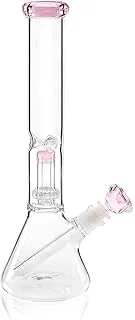
The iconic German beaker that defined scientific glass. Hand-blown in Bavaria with the signature Blue Line downstem, precision-ground joints, and legendary German engineering that's been copied but never equalled.
What We Liked
- Hand-blown in Germany using Schott-Rohrglas borosilicate
- Signature Blue Line downstem diffuses without drag
- Precision-ground 18.8mm joints — tight, wobble-free fit
- Ice pinch catches cubes for frozen, smooth hits
- Retains value — rare on UK secondary market
What Could Be Better
- Genuine RooR is expensive and hard to verify vs fakes
- Standard beaker has no percolator — basic diffusion
- Blue ring is purely cosmetic but adds cost
RooR is the name that started the scientific glass revolution. Back in the 1990s, German glassblowers started making beaker bongs from Schott-Rohrglas borosilicate — the same glass used in chemistry labs — and the Blue Line was born. Every cheap beaker bong you see today is a copy of this design. The original, however, is in a league of its own.
What Makes a RooR a RooR
The Blue Line downstem is a slotted diffuser that sits at a precise angle inside the ground-glass joint. It's not about fancy percolation — it's about clean, even diffusion with zero drag. The bore of the downstem is calculated to create optimal pressure, meaning you get a smooth, chugging hit without any of the whistle or resistance you get from cheap copies. The ice pinch isn't just for show either — it's positioned to hold three cubes securely, right in the path of the smoke for maximum cooling.
The Fake Problem
There are more fake RooRs in circulation than real ones. Genuine pieces have a sandblasted logo on the tube, a serial number, and the signature Blue Line downstem made from coloured glass (not painted). The joint welds are flawless — no bubbles or uneven glass. Expect to pay upwards of £150 for a small beaker, and £250-400 for a larger tube with ice pinch. It's a lot for a simple beaker, but you're paying for German engineering that will outlast you.
Water Level and Setup Technique
The Blue Line downstem only shows its quality when the water level is right. I fill until the slots sit comfortably submerged with a modest margin above them — enough that every slot bubbles evenly on the draw, not so much that the chamber fights you on the clear. You'll know it's right by the sound: an even, low chug with no gurgling or splash. Pack a medium grind with a light tamp, add two or three cubes to the ice pinch, and give the tube a minute to chill. That cold column above the water is half the smoothness equation on a tall RooR, so don't skip the ice.
Draw Character Against Modern Perc'd Beakers
Here's what three decades of refinement buys you: a draw with essentially no resistance quirks — no whistle, no uneven chugging, no dead spots. It's open and linear from first pull to clear, and the flavour comes through remarkably uncoloured. A modern percolator piece like the RORA honeycomb bong will give you a cooler, more diffused hit with more visible filtration action, and it costs a fraction of the price. The RooR counters with purity of flavour and a mechanical perfection that cheap glass never quite replicates. Compare the field in our best bongs UK roundup — the RooR wins on finesse, the perc pieces win on value and smoothness-per-pound.
Ownership, Durability and Cleaning
A genuine RooR is a buy-it-for-decades piece. The Schott borosilicate and flawless welds handle daily use gracefully, and the ground joints stay tight for years if you keep resin out of them — gritty joints grind themselves loose, so rinse the joint faces regularly rather than letting them cake. For full cleans, warm isopropyl and salt through the tube and a separate soak for the Blue Line stem keeps everything tasting pristine; never use boiling water, as thermal shock can crack even good glass. Full routine in our bong cleaning guide. Treat it well and you'll hand this to someone in twenty years still smoking like new.
RooR Blue Line Beaker FAQ
How do I know mine is genuine?
Check three things: a crisp sandblasted logo (not printed), a serial number, and a Blue Line downstem made from coloured glass rather than painted. Flawless welds with no bubbles, plus a price at or above £150, are further good signs.
Why buy this over a £30 beaker that looks identical?
Draw quality, joint precision, glass consistency and longevity. Copies nail the silhouette but not the bore engineering, the weld quality or the seal — differences you feel within the first few sessions and keep feeling for years.
Does the blue ring do anything functional?
No — it's cosmetic, a signature identifier. The functional magic is in the slotted diffuser geometry and the ground joint tolerances, not the colour.
Overall Performance Score
Based on multi-week usability, build quality, and real-world value.
Stop Guessing.
Find the Best Coffeeshops.
Taking your new vape to Amsterdam? Damlive maps out the city's top coffeeshops, live strain menus, and smoke-friendly spots so you never end up in a tourist trap.
Should You Buy the RooR Blue Line Beaker Bong?
The iconic German beaker that defined scientific glass. Hand-blown in Bavaria with the signature Blue Line downstem, precision-ground joints, and legendary German engineering that's been copied but never equalled.
#AD As an Amazon Associate, we earn from qualifying purchases. Prices correct at time of review.